You have just measured your bedroom at 12 by 15 feet, which gives 180 square feet of floor area. You are comparing air purifiers online, and each model lists a CADR number in cubic feet per minute. Some show 110, others show 220, and a few go well beyond 300. Which of those numbers is actually enough for your room? The Association of Home Appliance Manufacturers, or AHAM, answers this question with a widely used guideline called the two-thirds rule: the smoke CADR of a portable air cleaner should be at least two-thirds of the room area in square feet. For a 180-square-foot room, that means you need a smoke CADR of roughly 120 cubic feet per minute. This article explains where the rule comes from, how to apply it accurately, and when you should set the bar higher.
محتوى
CADR stands for Clean Air Delivery Rate. It is a performance score developed by AHAM and measured under the AC-1 test standard. In a sealed test chamber, the machine runs at its highest speed while sensors track how fast particles are removed. The result is expressed in cubic feet per minute, and it is published as three separate values: smoke, dust, and pollen. Smoke particles are the finest of the three, which is why the smoke CADR is almost always the lowest and the most conservative figure on the label.
The three numbers matter because a purifier does not remove every particle size with equal efficiency. A unit may show a pollen CADR of 240 and a smoke CADR of only 190. When you size a machine using the AHAM guidance, you should always use the smoke value, because it reflects the hardest cleaning task. This is also the value used in the two-thirds rule. Independent certification programs like AHAM Verifide publish these numbers so buyers can compare products on an equal basis. When a manufacturer does not list a smoke CADR at all, treat the product with caution.
Air washers and humidifier-style cleaners are evaluated this way too, so their smoke rating is equally relevant when you are deciding whether they can handle a room. CADR does not tell you about filter chemistry, odor removal, or long-term cost, but it remains the single most reliable starting point for room matching.
AHAM states the recommendation as a rule of thumb: the smoke CADR of a room air cleaner should be equal to at least two-thirds of the room area. In practice, you take the floor area in square feet and multiply it by 0.67. The result is the minimum CADR you should look for. If your room measures 10 by 12 feet, the area is 120 square feet, so the minimum smoke CADR is about 80 CFM. For a larger 20-by-20-foot living room, the 400-square-foot area pushes the minimum to about 267 CFM.
This rule is built on the assumption of a standard 8-foot ceiling and a target of roughly five air changes per hour. Five air changes per hour is generally considered adequate for common particle removal in a home or office setting. When the ceiling is higher or the space is not fully enclosed, the simple formula does not tell the whole story. Still, for most buyers, the two-thirds calculation is the quickest and most practical way to narrow down the many models on the market.
The horizontal bar chart above shows the minimum smoke CADR for common room sizes when you multiply the floor area by two-thirds. A 100-square-foot home office needs at least 67 CFM, while a 200-square-foot bedroom needs 133 CFM. The required rating climbs to 200 CFM for 300 square feet and to 267 CFM for 400 square feet. Because the rule is linear, every additional 100 square feet adds roughly 67 CFM to the requirement. If a purifier falls short of the mark, it will still clean the air but at a slower rate, which matters when particles are being generated continuously. Rounding up to a slightly higher rating gives you useful margin without a major jump in price.
| Room area (sq ft) | Example dimensions (feet) | Minimum smoke CADR (CFM) |
|---|---|---|
| 100 | 10 x 10 | 67 |
| 150 | 10 x 15 | 100 |
| 200 | 12 x 17 | 133 |
| 250 | 14 x 18 | 167 |
| 300 | 15 x 20 | 200 |
| 400 | 18 x 22 | 267 |
| 500 | 20 x 25 | 333 |
| 600 | 22 x 27 | 400 |
Applying the two-thirds rule takes about one minute if you follow a clear sequence. Measure the room at its widest length and its widest width. Multiply those two numbers to get the floor area in square feet. Multiply the area by 0.67 to find the minimum smoke CADR you need. Then look for the smoke CADR on the purifier label or the manufacturer spec sheet, not just the dust or pollen values. If the listed smoke CADR is at least your calculated number, the unit qualifies for that room.
Consider a 14-by-17-foot master bedroom with a floor area of 238 square feet. Your target smoke CADR would be 238 times 0.67, which equals about 159 CFM. A model rated at 160 CFM just meets the number, but a unit rated at 200 CFM gives you a more comfortable margin and continues to perform well when doors are open or candles are burning. Most manufacturers publish CADR for their air purifier models, so the comparison usually comes down to a single column of numbers.
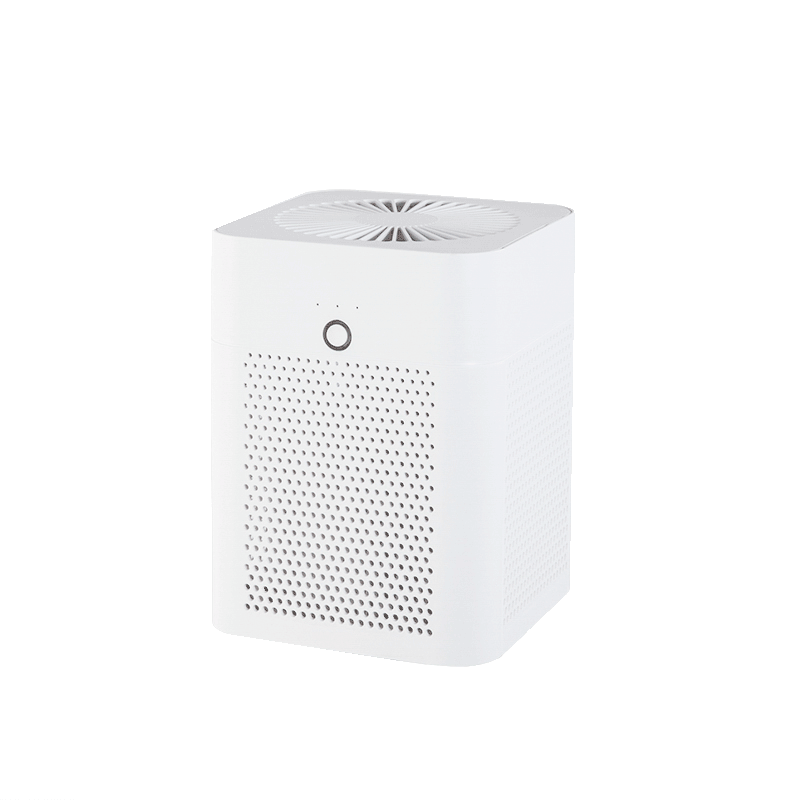 Houseuse Air Purifier with Certification for Reliable Room Coverage This certified air cleaner comes from an experienced manufacturer with large production capacity, making it a credible option when matching CADR to bedroom size and open adjacent spaces. View Product →
 For rooms that connect to hallways or open staircases, treat the adjacent space as part of the effective area. If the bedroom has a permanently open door to a 100-square-foot landing, the purifier is effectively serving 338 square feet, not 238. Add that extra area to your calculation, and you will avoid the disappointment of a machine that can only manage half of the real space.
The two-thirds rule produces a straight relationship between room area and the required smoke CADR. You can see that relationship in the line chart below. For every additional 100 square feet of floor area, the minimum rating rises by about 67 CFM. That makes the formula easy to use in reverse as well: divide the smoke CADR of any purifier by 0.67 to estimate the largest room it can handle. A 300-CFM machine, for example, would cover roughly 450 square feet under the rule. Keeping this curve in mind helps you avoid both undersizing and buying far more capacity than the room needs.
The line chart above plots the minimum smoke CADR from 100 to 700 square feet of room area. The line starts near 67 CFM and ends at roughly 467 CFM, rising in a steady diagonal. The shape is useful for quick mental estimates when you are comparing two or three purifiers at different price points. A machine rated at 200 CFM sits exactly at the two-thirds requirement for a 300-square-foot room. If your room is larger, the same machine falls below the line, and your effective air cleaning rate drops accordingly. That is why a purifier that works perfectly in a small office can feel useless in an open-plan living area.
The two-thirds rule works well for a typical enclosed room with an 8-foot ceiling, but real homes regularly deviate from that baseline. For rooms with ceilings above 8 feet, multiply the floor area by the actual ceiling height divided by 8, then apply the two-thirds factor. For an open floor plan, include the entire connected area that has no closed door between spaces. For heavier contaminant loads such as smoking, frequent cooking, or wildfire smoke, AHAM recommends a smoke CADR closer to the full room area rather than just two-thirds. Allergy sufferers also benefit from a rating above the minimum because their triggers arrive in sudden bursts.
The column chart above compares four scenarios for the same 300-square-foot room. The everyday baseline from the two-thirds rule sits at 200 CFM. Allergy season raises the practical target to about 240 CFM because pollen and dust arrive in heavier bursts. A household with smokers or frequent heavy cooking is better served near 300 CFM, equal to the full room area. For wildfire smoke, AHAM specifically recommends a smoke CADR that matches the room area, since fine particles linger longer and carry greater health risk. The story of these columns is simple: the two-thirds rule gives you the floor, and your lifestyle sets the ceiling.
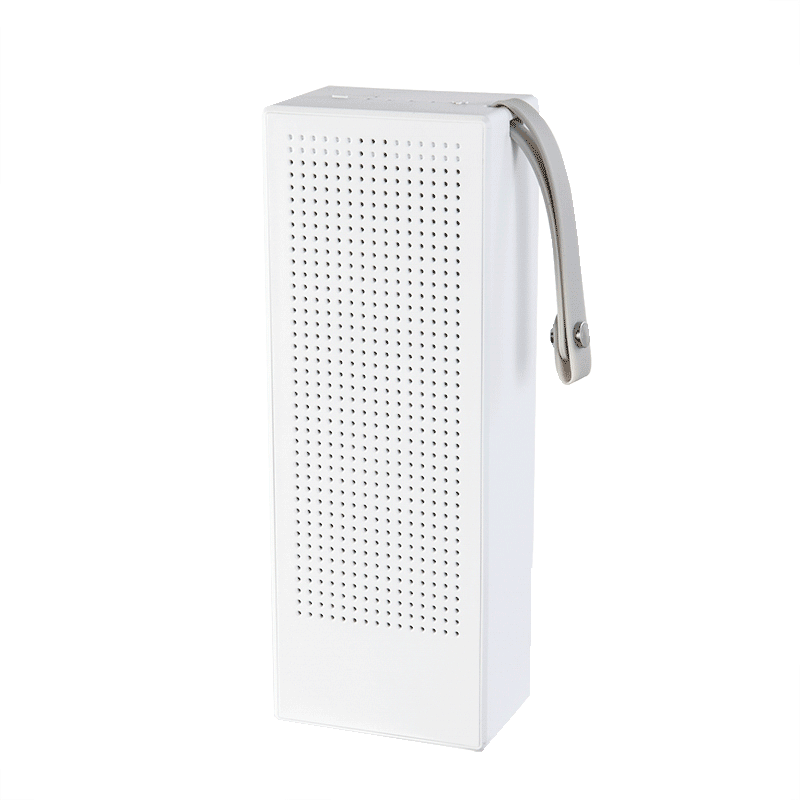 Portable Rechargeable Air Purifier RAP-02 with HEPA and Carbon Filters Equipped with H12 HEPA, carbon filtration, and three speeds, this rechargeable portable unit suits rooms with higher ceilings where flexible placement between bedroom and office is needed. View Product →
 Higher ceilings deserve a closer look because the rule is area-based, not volume-based. A 200-square-foot room with a 10-foot ceiling contains 25 percent more air than the same footprint with an 8-foot ceiling. Multiply 200 by 10 divided by 8 to get 250 effective square feet, then apply two-thirds to arrive at 167 CFM instead of 133 CFM. Portable units with higher CADR and flexible placement are a convenient answer for these situations, especially when you need to move the machine between a bedroom and a home office during the day.
CADR answers the question of how fast a purifier removes particles from a standard room, but it does not cover every factor that determines real-world satisfaction. Filter efficiency matters because a machine with a lower CADR but a true HEPA filter can still outperform a higher-CADR unit that allows more particles to pass through. Noise is equally important, because the CADR is measured at the highest fan speed, and that is often not the speed you will use overnight. Energy consumption and the cost of replacement filters also shape the total ownership cost. Placement affects performance too: a purifier tucked behind a sofa cleans far less air than one positioned in an open area with clear airflow on all sides.
The radar chart above compares three kinds of air purifiers across five attributes, with higher scores meaning a stronger result in that dimension. A compact personal unit scores low on raw CADR output but wins on noise control, energy efficiency, and running cost. A mid-size room unit balances decent output with moderate noise and acceptable energy draw, which is why it fits most bedrooms and offices. A large room unit delivers the highest CADR and the best filter coverage, yet it usually comes with more fan noise and higher electricity consumption. What this comparison shows is that the biggest rated machine is not always the best fit for the two-thirds rule. You may satisfy the minimum with a smaller, quieter unit and still get better day-to-day performance. Think of CADR as the speedometer and the radar chart as the rest of the dashboard.
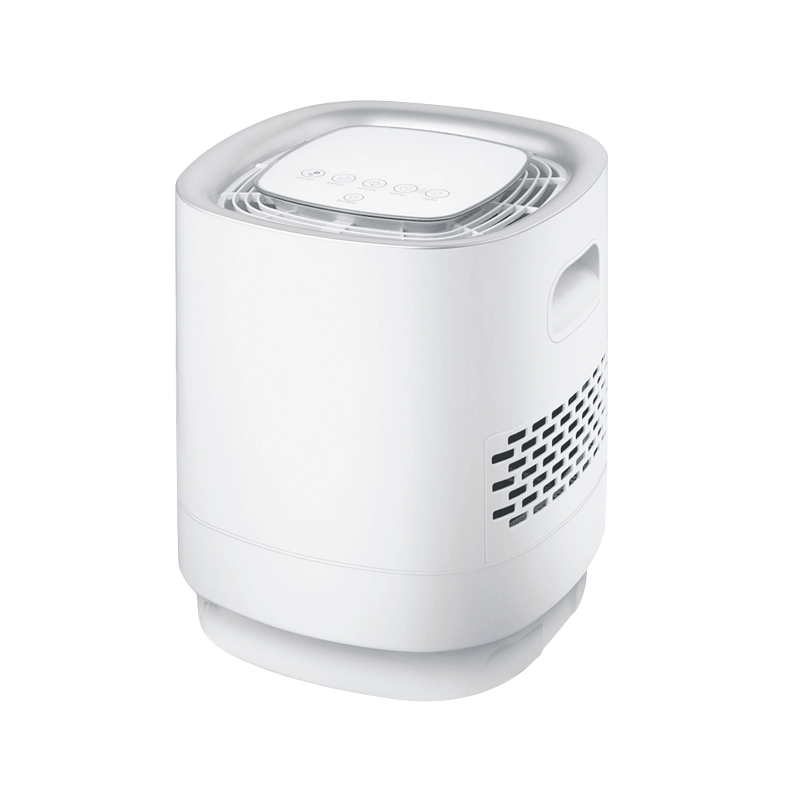 Multifunction OEM Airwasher LG-02 with Continuous Running Time As an airwasher with continuous operation, this model balances performance and efficiency, fitting buyers who want a mid-size solution without the noise and power draw of larger units. View Product →
 Even buyers who understand the two-thirds rule still make errors when they move from calculation to purchase. The most common ones are easy to name.
A useful habit is to recalculate the requirement once a year or whenever you change rooms. The calculation is cheap, honest, and takes less time than reading another review. When you compare models, look for the certified rating rather than a maximum fan airflow number. Airflow and CADR are not the same; the first measures how much air the fan moves, while the second measures how much cleaned air is actually delivered after filtration. Several units advertise impressive airflow but deliver a much lower CADR, and that gap is exactly what certified testing exposes.
The AHAM two-thirds rule is the closest thing the air purifier industry has to a universal sizing equation. Measure the room in square feet, multiply by 0.67, and look for a certified smoke CADR at or above that number. For a typical home with standard ceilings and ordinary dust levels, that single step prevents most sizing mistakes. When the ceiling is higher, the plan is open, or the air contains smoke and allergens, raise the target toward the full room area. The result is a purifier that clears the air at a visible pace instead of running continuously without making a difference.
Buyers who need a specific recommendation can start by exploring the air purifier product range and matching the published CADR to the room they plan to use. The two-thirds rule works the same way for a compact model and a large floor-standing unit, because the math is blind to brand. Treat the rule as the floor, select a model with a little margin above it, and you will have a machine that works the way the label promises.
For a deeper look at how purifiers handle typical residential and office air, the article on how air purifiers clean the air in your home covers the basics of everyday use. Sizing is only half of the job; the other half is placement, filter maintenance, and realistic expectations about the speed of a portable room cleaner.

@ 2020. شركة CIXI XIATIAN للأجهزة الكهربائية المحدودة. كل الحقوق محفوظة. مصنعي مراوح كهربائية عالية الجودة بالجملة



 إنجليزي
 한국어
한국어